
Origin Markets: Bridging NFTs & IP

NFTs became one of the cornerstones of mass crypto adoption, serving as the iconic identifier of the crypto revolution since 2021. Companies tokenized memberships, artists conducted ticket sales, and creators raised millions by selling their art onchain—unlocking a new era of digital ownership and financial markets.
But even as NFTs became synonymous with crypto art and established themselves as a cultural phenomenon, they never bridged the critical gap between ownership and intellectual property. The IP rights remained ambiguous even after collectors paid six figures for an onchain JPEG. You owned the token, but what did you actually own? Could you use the artwork commercially? Create derivatives? License it to brands? The answer was usually unclear, governed by vague terms of service or Twitter threads rather than enforceable, programmatic rights.
NFTs and IP: Separate Worlds
NFTs and IP have mostly lived in separate worlds. Ownership of a token didn’t clearly translate into ownership or control of the underlying rights. Take Yuga Labs as an example: commercial rights were granted through a license, but that license existed as a PDF on a website, not on-chain. When an Ape was sold, it wasn’t obvious whether those rights transferred automatically. If someone made art using their Ape, it was unclear who owned the resulting IP. And if a brand wanted to license fifty different Apes, they had to deal with fifty individual holders, each with their own understanding of what they could or couldn’t do.
The market tried to patch over these gaps with social norms and the occasional legal letter, but that never scaled. Creators effectively gave up control of their IP once they sold an NFT. Buyers often didn’t know what rights they were actually getting. Derivative creators worked in legal gray areas, always at risk of takedowns. And serious brands largely stayed away, unwilling to build on foundations that were legally vague and fragmented.
Yuga Labs NFT takedowns (Blockworks)
Introducing IP-NFTs: Programmable Intellectual Property
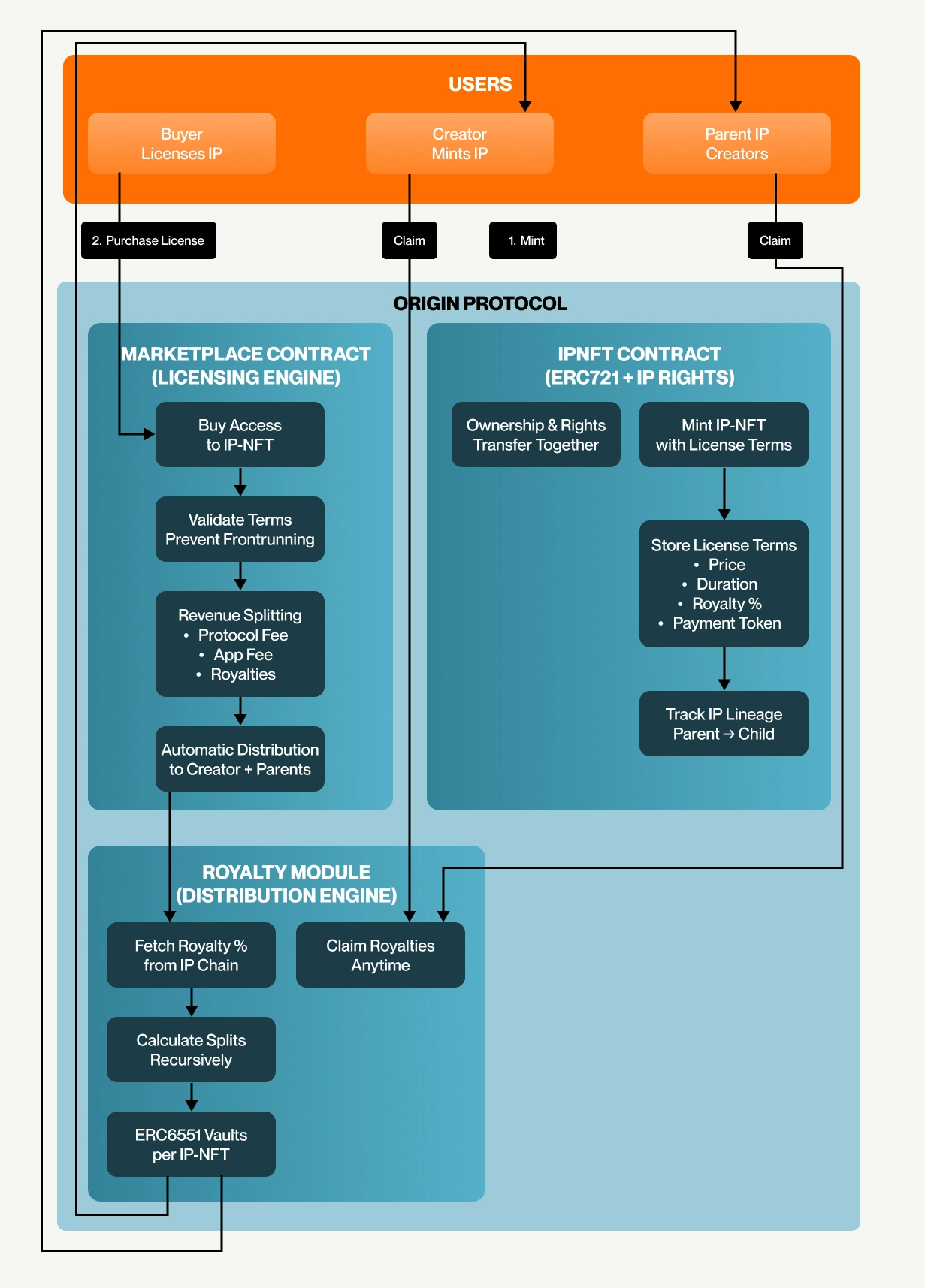
Origin Markets introduces IP-NFTs — an onchain primitive that encodes ownership and IP rights in NFTs. Where traditional NFTs point to an image with vague legal terms living somewhere off-chain, IP-NFTs embed the intellectual property rights directly into the smart contract, handling everything from royalties to co-creation.
IP-NFTs are first-class citizens of Camp Network. The rights are embedded, transferable, and programmatically enforceable without any intermediaries or legal interpretation required.
How Rights Become Programmable
IP-NFTs work by encoding license terms as structured data within the token itself. When someone mints content as an IP-NFT, they specify exactly what rights they’re selling and under what conditions. These terms are defined as:
struct LicenseTerms {
    uint256 price;           // Price in wei (for native CAMP) or token units
    uint32 duration;         // Duration in seconds (0 for non-subscription)
    uint16 royaltyBps;       // Royalty percentage in basis points (e.g., 8000 = 80%)
    address paymentToken;    // Payment token address (address(0) for native CAMP)
    LicenseType licenseType; // Type of license (see enum below)
}
Origin allows users to mint, license, and monetize IP onchain, fully compliant with the x402 agentic standard so users & AI agents can discover, license, and pay automatically. At its core, Origin combines programmable licensing with native payments, enabling creators to sell, license, and attribute their IP without intermediaries.

Origin tracks the full IP derivation tree onchain. Every remix references its parent IP, and when content is licensed, royalties are automatically routed to every creator in the chain. Original creators earn from all downstream use, while derivative creators can build freely by paying preset royalties—no permissions, negotiations, or intermediaries required.
The Automatic Royalty Revolution
AI demands a scalable IP layer. Human-by-human licensing cannot support billions of AI-generated works and transactions. Licensing must be machine-to-machine, instant, and fully programmatic.
With Origin’s X402 integration, AI agents can discover content, read onchain license terms, negotiate dynamically if supported, purchase rights, and use the content in seconds. Payments settle automatically, and creators are paid instantly without manual involvement.
New Creative Economies
Origin unlocks new economic primitives:
- Fractionalized IP ownership: Creators can sell portions of high-value IP while retaining upside. Fans and investors earn proportional royalties, becoming aligned stakeholders.
- Prediction markets: Creators can launch markets around future releases, enabling early price discovery and viral signaling. Market participation itself drives attention, creating powerful feedback loops.
The Network Flywheel
Origin’s power grows superlinearly with adoption because it creates multiple reinforcing feedback loops.
Catalog loop: More creators minting IP-NFTs means a larger catalog, which attracts more buyers, which generates more revenue per creator, which attracts more creators. Each IP-NFT minted makes the network more valuable to everyone else.
Derivative loop: High-quality original IP incentivizes derivative creation because royalties flow back. Those derivatives increase the original IP’s exposure, raising its value, which incentivizes more high-quality original creation. The IP that generates the best derivative ecosystem becomes most valuable.
Platform loop: Platforms integrating Origin enable their users to mint IP-NFTs, which generates licensing fees, from which platforms earn revenue shares, incentivizing more platforms to integrate. Each integration expands the network and increases its liquidity.
Capital loop: Capital markets developing around IP-NFTs—lending, fractionalization, prediction markets—make IP more valuable and liquid, attracting more capital, deepening markets, creating more sophisticated financial products. Every primitive built on top makes the base layer more valuable.
This flywheel is not limited to just crypto but extends to general internet consumer markets where users stick because of the social effects.
Explore Origin on Camp