
The IP Endgame: How Camp is Finally Handing Ownership Back to Creators

Intellectual property lies at the heart of every human interaction.
Whether you are streaming on Spotify, using a Photoshop filter, or posting to Instagram, you are constantly interacting with licenses, patents, and copyrights.
But Behind every screen is a complex system attempting to track usage and compensate creators - or, more often, attempting to evade those obligations entirely.
What’s Happening Today
Today, the infrastructure for managing these rights is fundamentally broken. AI companies train on copyrighted content without permission, and platforms often use music without proper licenses. For the individual creator, the situation is even worse:
- The Wait: Registering a copyright can take 18–24 months.
- The Cost: Legal fees often run between $300–$500 per work.
- The Loss: Platforms suck out the majority of royalties, leaving creators with fractions of a cent.
In this article, we’ll trace the journey of IP from its beginnings as paper certificates to the current digital era.
Most importantly, we’ll explore how we are finally entering the era of Programmable IP, where the rules of ownership are baked directly into code.
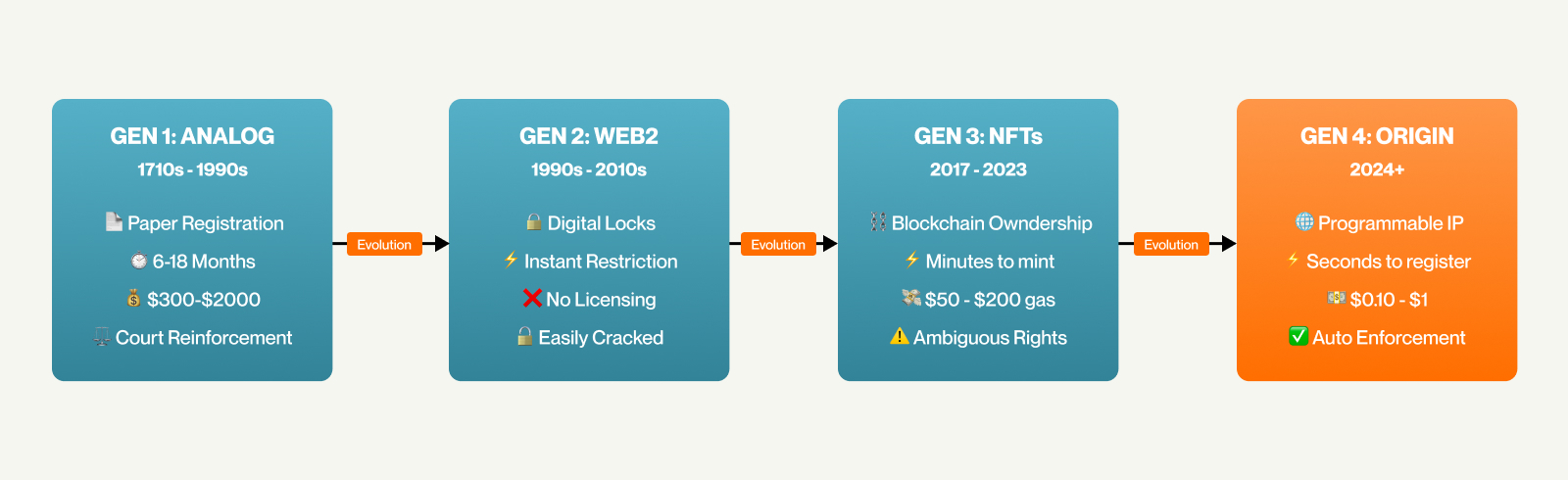
The Four Generations of IP
Generation 1: Analog Systems (1710 – 1990s)
The first generation of IP rights emerged with the Statute of Anne in 1710, establishing statutory copyright in Britain.
This model → centralized government registries, paper documentation, geographic jurisdiction—defined IP management for nearly three centuries.
- How it worked: You filed physical applications with government offices, waited months for a manual review, and received a paper certificate.
- The Innovation: For the first time, the law protected creators against unauthorized copying.
- The Limitations: It was slow, geographically fragmented (you had to file in every country separately), and effectively inaccessible for small creators who couldn’t afford lawyers.
Generation 2: Digital Rights Management (1990s-2010s)
The internet made copying free and instant, nearly destroying the music and film industries.
Napster enabled 80 million users to share billions of songs with zero compensation to artists. Hollywood feared BitTorrent would destroy the film business. Publishers saw ebook piracy explode overnight.
Their response was Digital Rights Management (DRM) - encryption “locks” placed on digital files.
- How it worked: Files were locked so they could only play on authorized devices (like a Kindle or an iTunes account).
- The Innovation: It gave rightsholders technical control over distribution without needing a courtroom.
- The Limitations: It birthed “Gatekeepers.” Companies like Spotify, Netflix, and Amazon built empires on this infrastructure, while the actual creators got squeezed, earning tiny margins while the platforms captured the value.
Generation 3: NFTs - Ownership Without Rights (2017-2023)
Blockchain introduced digital scarcity. NFTs proved that you could own a unique digital item without a central authority.
- How it worked: Creators minted ERC721 tokens on a ledger (like Ethereum) to prove who owned a specific image or file.
- The Innovation: Digital ownership became instantly transferable and transparent.
- The Failure: NFTs proved ownership, but not rights. If you bought an expensive NFT, you often didn’t actually own the legal right to use that image commercially. The legal “license” was usually a separate document stored elsewhere, leaving creators and buyers in a legal gray zone.
The NFT boom revealed the gap between provable ownership and actionable intellectual property rights.
Collectors owned tokens but couldn’t confidently license, sublicense, or enforce their IP. Creators sold NFTs but earned nothing when buyers profitably exploited the IP commercially.
Derivative creators operated in legal gray zones, never sure if they’d receive cease-and-desist letters.
Generation 4: Origin IP-NFTs - Programmable Rights Infrastructure (2024+)
Origin Protocol represents the next leap: making licensing inseparable from ownership.
Instead of bolting legal rights onto a token, Origin embeds the entire license (price, duration, and royalties) directly into the smart contract code.
How it works: When you mint an IP-NFT on Origin, you aren’t just registering a file; you are embedding machine-readable data (onchain) that defines how that file can be used.
When a user or AI wants access, they call the buyAccess() function. In one single transaction, the contract validates terms, processes payment, distributes royalties across the entire creative chain, and grants verifiable access rights.
Architecture innovations:
Embedded License Terms: Every IP-NFT contains structured licensing data as part of the token itself. Three license types serve different needs: single-payment (perpetual rights), duration-based (subscriptions with automatic expiry), and X402 (dynamic AI agent negotiation).
Automatic Attribution Chains: When a derivative work is created (like a remix), the smart contract permanently links it to the parent IP. Royalties flow automatically to the entire lineage - creator, parents, and grandparents - instantly and proportionally.
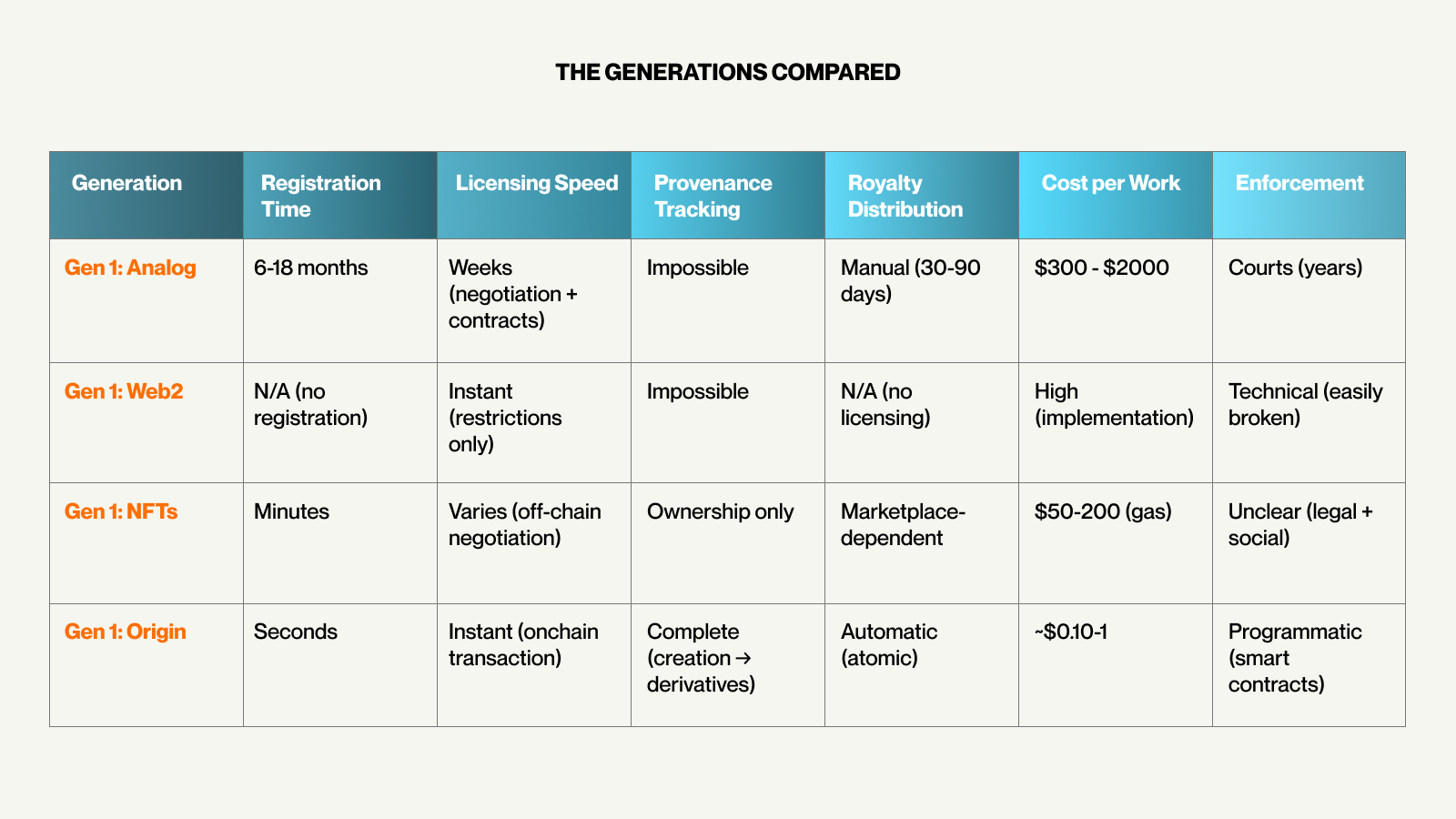
Atomic Settlement: Traditional IP payments take 30–90 days. Origin settles in real-time. The marketplace contract splits revenue between protocol fees and creator vaults (ERC6551) simultaneously. There is no debt, no defaults, and no manual accounting.
Onchain Provenance: Every ownership transfer, license purchase, and derivative relationship is recorded. Anyone can query the history of an IP to see who created it, who licensed it, and how much revenue it has generated.
Dispute Resolution: If a copyright claim arises, CAMP token stakers vote on the dispute. If a claim succeeds, the IP-NFT is marked as “DISPUTED,” blocking further licensing. This creates a transparent, auditable system that doesn’t rely on a central platform.
The Result: From Idea to Monetization in Minutes
Through Origin, the entire lifecycle of a creative work is now automated. A photographer mints an image; a brand buys a license in one click; an AI agent uses that image to generate a new composite work and mints it as a derivative.
When a third party licenses that AI image, the royalties flow back to both the AI agent and the original photographer automatically.
IP ownership is finally programmable, transparent, and trustless.
Start Creating on Origin