
The Institutionalization of Crypto

Institutions Are Actually Using Crypto Rails
2025 was the year crypto stopped being treated as a side experiment by large financial institutions and started being used as real infrastructure.
BlackRock, Apollo, Hamilton Lane, JPMorgan, and Societe Generale did not just test blockchain rails in sandboxes. They deployed actual products, moved actual capital, and proved that tokenization could support institutional finance at scale.
The numbers made that shift impossible to ignore:
- BlackRock’s BUIDL fund crossed $2.5 billion.
- Apollo’s ACRED delivered 11.7% yields to onchain investors.
- Hamilton Lane dropped minimums from $2 million to $10,000.
- JPMorgan launched a tokenized money market fund on Ethereum.
- Societe Generale became the first regulated bank to extend its loan book through DeFi.
- Morpho’s RWA deposits grew from nearly zero at the start of 2025 to more than $400 million by Q3.
- The CFTC recommended tokenized funds as eligible collateral.
- Binance and OKX accepted BlackRock’s BUIDL for trading margin.
These are not just new headlines. They are balance-sheet decisions by trillion-dollar institutions using onchain rails for real financial activity.
Private credit - historically the domain of banks, PE firms, and institutional allocators - is being rebuilt onchain. And it is working.
The question is no longer whether real-world assets belong on blockchain. The question is which assets come next.
The Playbook
Every successful RWA tokenization has followed the same basic pattern:
- Take an illiquid institutional asset.
- Wrap it in a legal structure.
- Tokenize it through compliant infrastructure.
- Open a vault for deposits.
- Route real-world cash flows back to token holders.
Apollo did this with corporate credit. BlackRock did it with Treasuries. Hamilton Lane did it with private equity. Pareto is doing it with institutional lending.
The underlying asset does not change. The wrapper changes. The vehicle changes. And with that, everything about the asset changes: who can access it, how it can be traded, and what it can plug into onchain.
When Apollo launched ACRED, it did not reinvent credit underwriting. It took an existing $1.2 billion diversified credit fund and made it accessible through a tokenized feeder structure. Same assets. Same manager. New rails.
Crypto infrastructure is now mature enough to onboard institutional-scale assets without forcing those assets to become something else.
The Gap
But look at what has been tokenized so far: Treasuries, real estate, corporate debt. The same categories, again and again.
BlackRock dominates tokenized Treasuries. Apollo and Maple compete in corporate credit. The blue-chip RWA verticals are already crowded.
Meanwhile, one of the world’s most valuable asset classes remains largely untouched:
Intellectual property.
Music catalogs generate recurring streaming royalties. Films produce box office receipts, licensing revenue, and international distribution cash flows. Festivals sell tickets with years of historical demand data behind them.
More than 80% of S&P 500 market cap now comes from intangible assets - brands, content, patents, and data - yet those assets remain mostly frozen on balance sheets, inaccessible to capital markets, and invisible to DeFi.
A musician generating $2 million in annual streaming royalties still struggles to borrow against that revenue without selling a catalog at a discount. A studio with predictable distribution income still relies on slow, expensive financing. The infrastructure that now works for corporate credit should also work for entertainment IP.
The gap is not technical. The gap is attention.
The market has spent years trying to bring traditional finance onchain while ignoring the asset class native to the internet and the creator economy.
Why IP Is Different
Intellectual property is not just another RWA category. It has traits that make it unusually well-suited for onchain infrastructure.
First, the cash flows are increasingly digital and traceable. When a song is streamed on Spotify, there is a record. When a film is sold on iTunes, there is a record. Compared with real estate or private loans, the oracle problem is much simpler because the underlying data exhaust already exists.
Second, IP is culturally legible. Institutional investors may get excited by credit spreads. Most people do not. But they understand movies, songs, and festivals immediately. They already invest emotionally in these assets. Tokenization lets them participate financially too.
Third, the creator economy is underserved by traditional finance. Banks rarely know how to underwrite a music catalog. Private equity often extracts value instead of partnering with creators. Existing options are slow, expensive, and frequently predatory. Studios and artists are not being asked to adopt new technology for its own sake; they are being offered better financing rails.
How It Works
The model mirrors what Apollo and Securitize built, adapted for entertainment.
A studio, label, or festival approaches Camp with a financing need. Camp underwrites the deal by verifying ownership, modeling cash flows, and assessing risk. An SPV is created to hold the IP rights - the same legal structure used in traditional entertainment finance, now connected to onchain rails.
A vault opens on Camp Network. Investors deposit stablecoins and receive vault shares representing claims on future revenue. Minimums can drop. Access can broaden globally, subject to compliance. Terms become programmable and transparent instead of bespoke and opaque.
As the IP generates cash flows - streaming royalties, ticket sales, licensing fees - revenue flows through the SPV into the vault. Oracles report performance onchain. Smart contracts execute the waterfall. Shares appreciate, accrue yield, or become redeemable based on actual performance.
This is where the model becomes more interesting than a static tokenized security.
Because Camp integrates with Morpho, IP vault shares can become collateral. Investors can borrow against a position without exiting. They can hedge it, loop it, or route it into automated strategies.
That is what turned tokenized credit into something more powerful than a PDF wrapped in a token. The asset became composable. Camp extends that same composability to IP.
Tokenized entertainment assets stop being passive yield products and become programmable financial primitives.
Market
Private credit is a $1.7 trillion market. Entertainment generates more than $300 billion in annual revenue. The overlap between those markets is still mostly greenfield.
Everyone building in RWAs is chasing the same collateral pools. IP is different. It is underserved, culturally resonant, and easier for a broad base of investors to understand.
“Invest in movies” is a simpler story than “invest in structured corporate credit.” Everyone understands what a film is. Very few people understand a securitized receivable.
Even a small share of entertainment financing moving through tokenized structures would be meaningful. If just 1% of annual entertainment revenue flowed through onchain vehicles, that would represent roughly $3 billion in deal flow.
What This Means
For studios, the value proposition is straightforward: capital arrives faster, investor access becomes global, terms improve as banks are disintermediated, and financing structures can preserve more creative control.
For investors, entertainment returns become accessible outside Hollywood’s traditional gatekeepers. Transparent cash flows replace black-box accounting. Lower minimums replace million-dollar thresholds. Secondary liquidity can replace decade-long lockups. And DeFi composability means positions can be borrowed against, hedged, and combined with other strategies.
This is real yield from real assets - not inflationary emissions, not recursive leverage, but actual cash flows from actual entertainment.
The Transparency Unlock
Traditional credit markets are opaque. Problems surface late and spread fast because the information asymmetry is structural.
Entertainment is even worse. Studios have been sued for decades over profit participation. Revenue disappears into overhead allocations, distribution fees, and accounting conventions designed to protect insiders. Net-profit participants can get cut out even on successful projects.
Onchain infrastructure changes that balance of power.
Smart contracts do not hide revenue. Oracles can report performance as it happens. The blockchain becomes the source of truth for what a song earned, what a film sold, and how proceeds moved through the waterfall.
For an industry built around creative accounting, that is not just a technical upgrade. It is a governance upgrade.
Why Camp
Camp Network was built from the ground up for IP and finance.
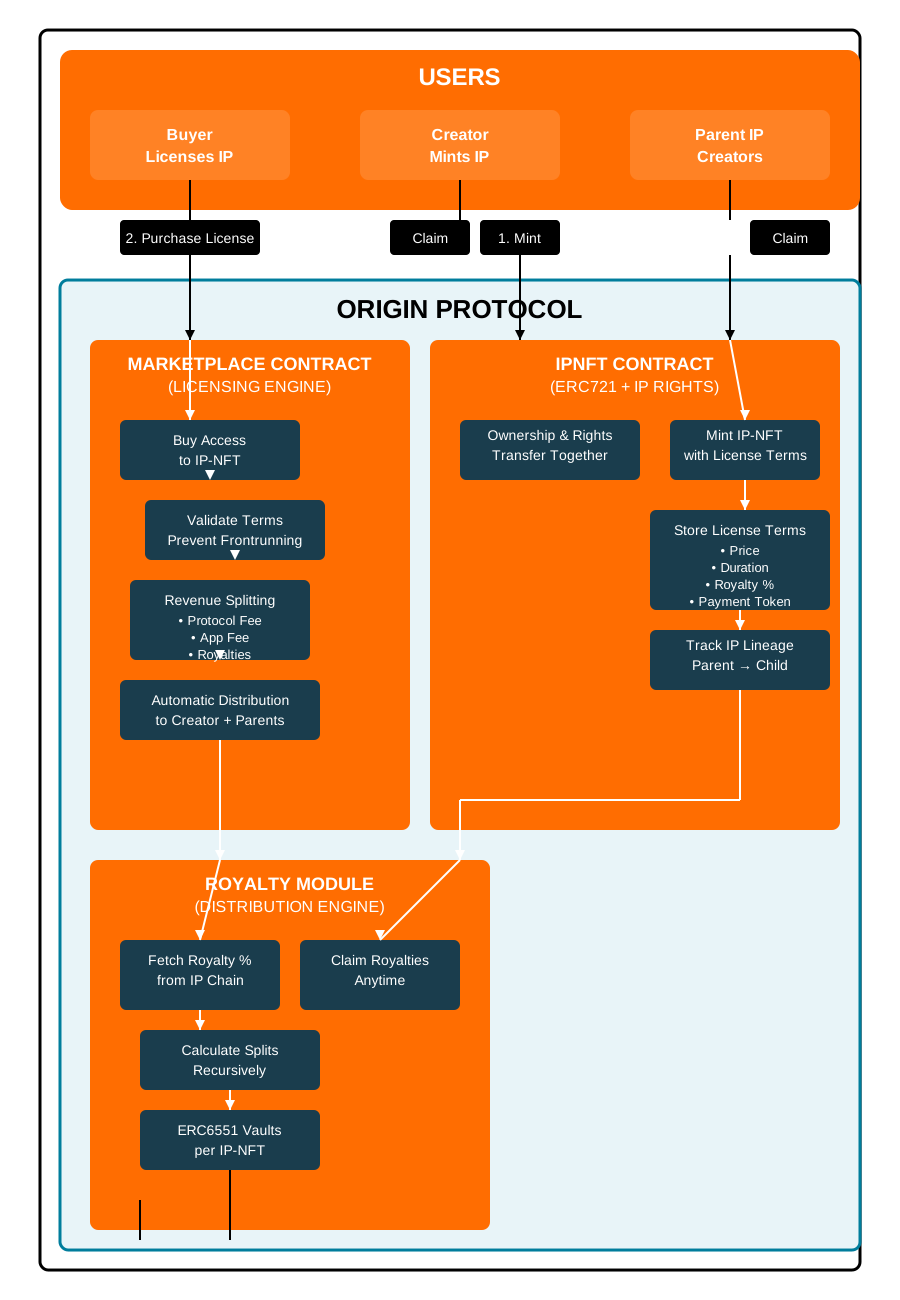
It is a Layer 1 designed specifically for intellectual property: native royalty distribution, onchain licensing, oracle integrations for streaming and revenue data, and compliance hooks for securities wrappers. General-purpose chains can support almost any asset, but Camp’s architecture assumes IP as a primary use case rather than an afterthought.
Just as importantly, the vault stack is already live. Camp has integrated Morpho vaults, the same composable lending infrastructure used by institutional credit markets. Camp has also integrated Elixir vaults for institutional-grade liquidity.
This is not a roadmap slide. It is working infrastructure.
When Pareto wanted to make credit vault tokens composable, it spent years building those integrations. Camp starts with the vault layer, the liquidity layer, and the composability layer already in place.
That matters because the path from experiment to institutional adoption has already been written. Apollo and BlackRock proved the model with conventional RWAs. Camp can take that same playbook and apply it to one of the largest undercapitalized asset classes on the internet.
The next wave of RWAs will not just be more Treasuries.
It will be the assets that define the digital economy.